• Free beginner's series
    • 2026 class schedule
    • Class membership
    • Cyclists course
  • Sign In My Account
Menu

Becci Curtis Yoga

Street Address
City, State, Zip
Phone Number

Your Custom Text Here

Becci Curtis Yoga

  • Online classes
    • Free beginner's series
    • 2026 class schedule
    • Class membership
    • Cyclists course
  • Sign In My Account

Do your wrists feel weak? Part 1: Mobilise

May 17, 2023 Becci Curtis
A yoga teacher has a pained facial expression while holding onto her wrist.

Would you believe that I don’t even pose for these things?!

If your wrists feel weak, taking part in a floor-based movement (or fitness) class will probably be a frustrating experience. Even in beginner-level classes, you are likely to find many positions that require you to place some bodyweight through your hands, like:

  • Table (all fours) and cat-cow

  • Downward dog and upward dog

  • Plank and push-up

If you have trouble holding (or starting in) any of these positions, you are presented with limited options to make things more manageable:

  1. Skip it

  2. Spend less time there and/or

  3. Bend your knees/place your knees down on the floor

All of these options are valid. They might suit you and what you are trying to achieve perfectly well, and they could be very appropriate ways to keep your body moving while coping with a flare-up, or accommodating an injury. They are not options to be scoffed at, or to make you feel less than.

However (really just a nice way to avoid saying ‘but’), if these are your limited options simply because you don't know what else you could try, keep reading.

This blog series is going to give you some extra and alternative options to consider.

Part 1: Mobilise (scroll down)
Part 2: Strengthen
Part 3: Adapt (coming soon)

Are your wrists capable of more movement?

Let’s start with what seems to be the ‘easiest’ position: table (all fours).

A yoga teacher demonstrates table position (all fours).

Table may look easy (or leave you feeling like it should be easy), but it’s only accessible if 1) you can get to the floor and 2) your wrists feel capable of moving enough to place your palms flat on the floor.

So – for now – we’re going to leave the floor out of the equation and focus on the movement of your fingers, hands, and wrists.

You can try these simple movements wherever and whenever you and your wrists feel like it: in the shower, at your desk, in class, on the train, standing in line. You can test them out in many different positions like: standing, sitting, kneeling, and lying down.

Auto-generated captions are enabled for these clips. To view them: press play, and click ‘cc’ to the right of the volume control at the bottom of the video player.

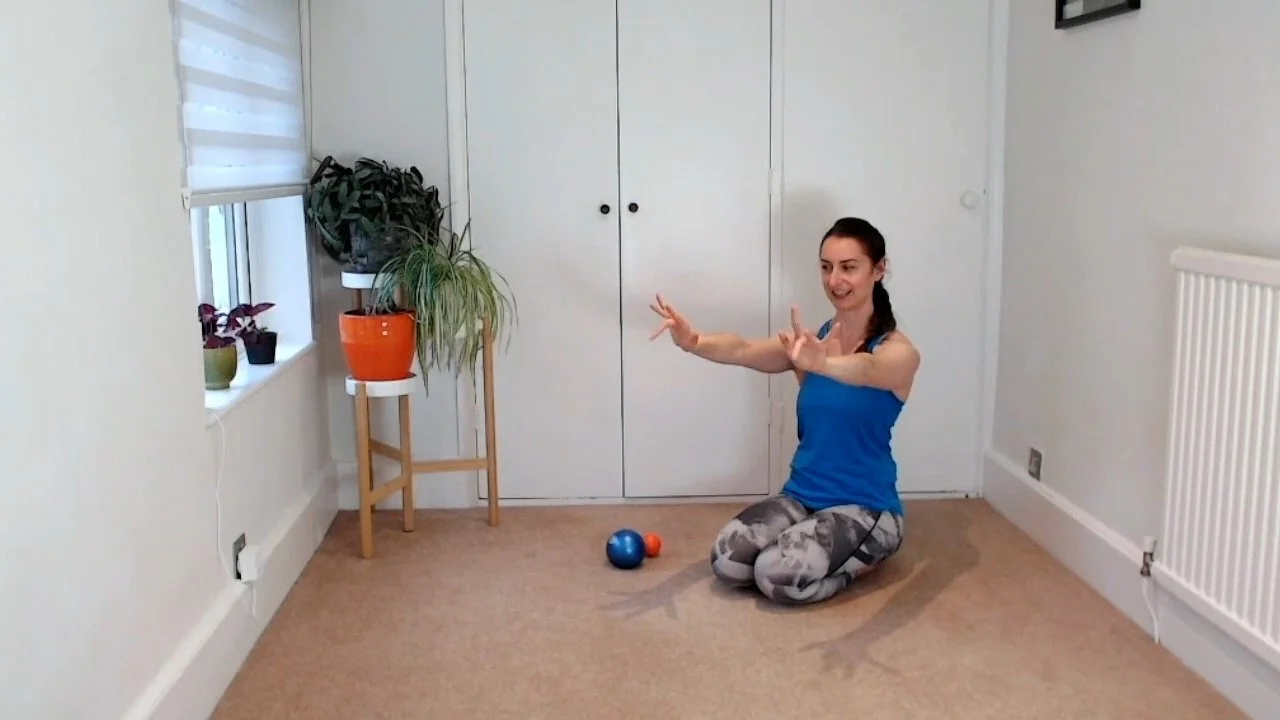
Wrist circles, air push-ups, and finger wiggles

These will get your wrists moving: no stress, few rules, all the feels.
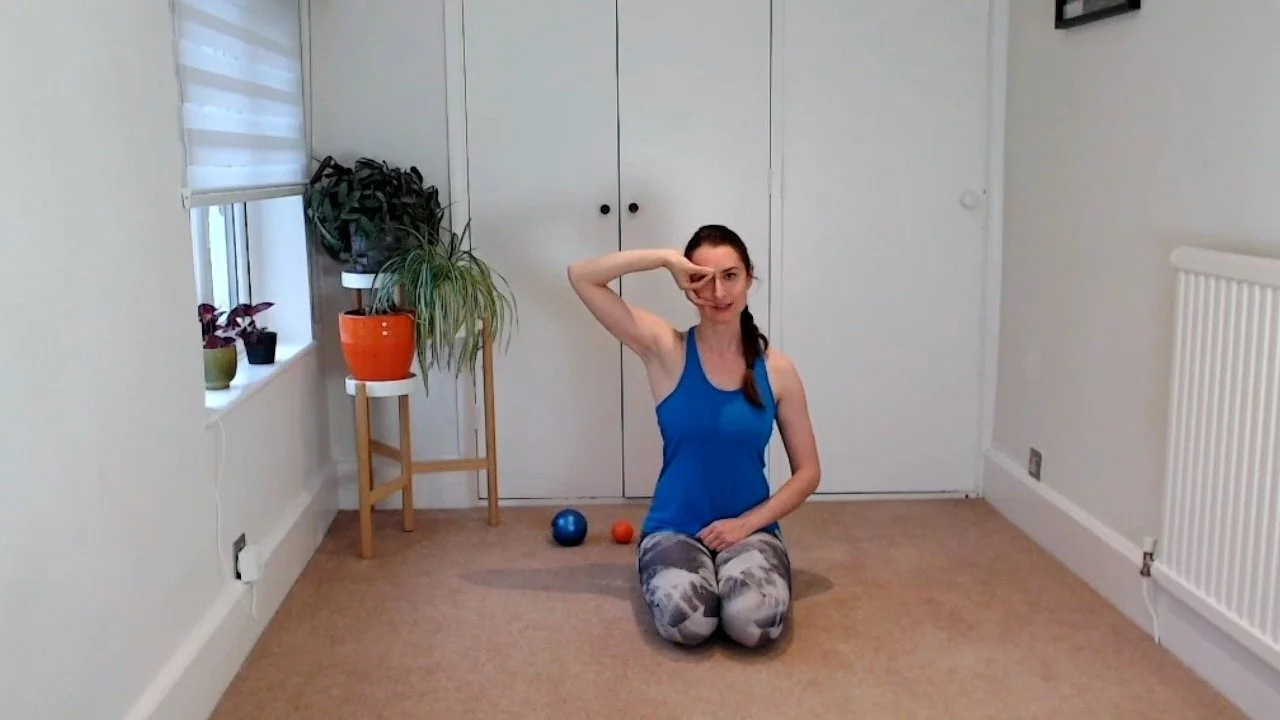
Eye-spy a book!

Shout out to my fellow nerds. TW: Speccy(-Becci)-four-eyes.
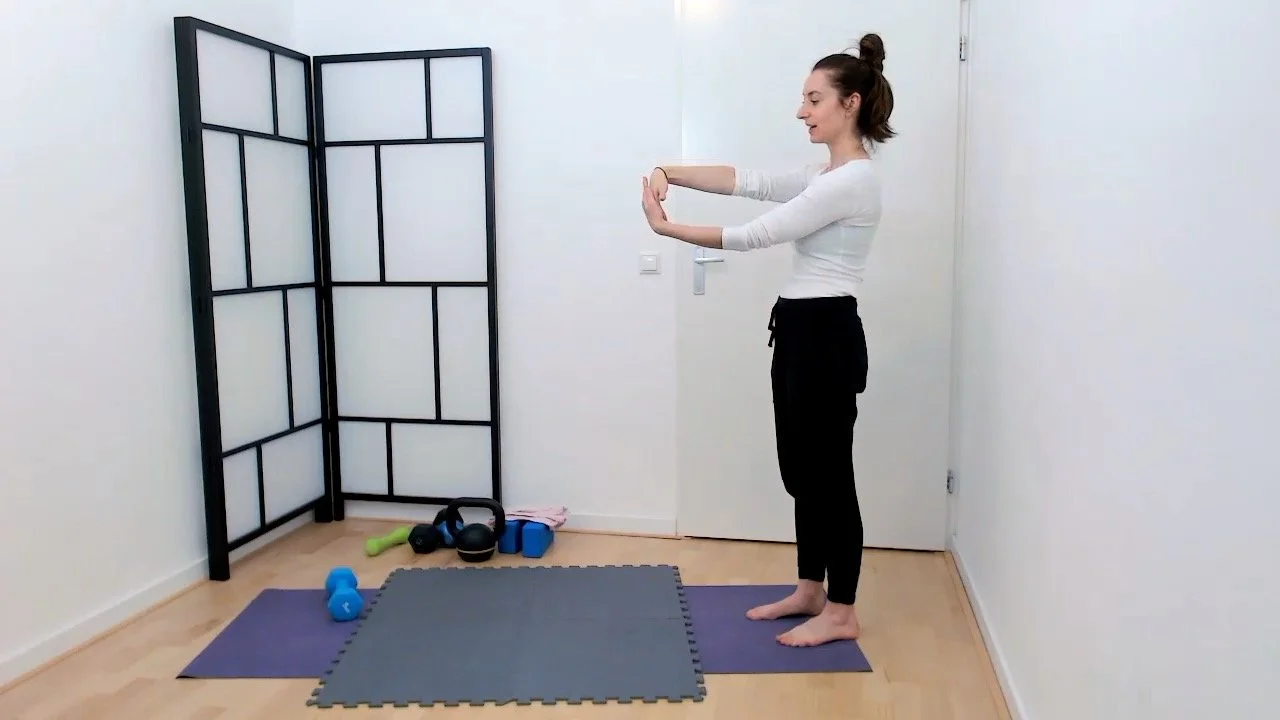
Two wrist-focused stretches

There is an option for you to make use of a wall in this one.
Some answers to your questions

How can I fit these into my yoga and movement class? Will I look like I’m copping out?

If your wrists feel like they need more time to warm-up, try these movements before class and see if they help. During the class, perhaps you can try adding these movements between (or in place of) the things that feel too challenging, or too sore for your wrists (right now).

They are legit movements to practice in their own right, so you don’t need to do more, or feel like you’re copping out. If you’ve committed your free time to moving your body, it’s probably because you want to look after it and do something good for yourself. Why waste your time doing something that limits your physical movement, or forces you to put a brave face on, struggle through, and pretend it all feels fine? It doesn’t matter what you look like if you know that you are making the right choices for yourself in that moment.

Do I need to do these in a set order? How many times?

You do not have to do these in a specific order, for a set amount of repetitions, or a set amount of time. You do not have to do them all. Pick one, try it out, and see what happens. Then stick with the one(s) you like and/or feel to be the most helpful, drop the rest. Maybe none of them work for you, that’s fine: perhaps you will discover some new movements of your own!

How should it feel? Am I doing it right?

These might feel a bit ‘crunchy’ and not totally comfortable, especially to begin with. Do a little, see how your body responds, maybe do a little more, or less. You’d have to put in sooooo much effort to go wrong: are you swinging from a lampshade while your neighbour pulls your thumbs backwards? No? Ok then, you’re probably good.

When can I progress to strengthening?

These are just simple ways to get you moving your wrists more often, not things you need to ‘perfect’. You don’t have to wait: you can start adding in some strength-building exercises now.


Is your question unanswered? Leave a comment below, or send me an email.

In Practice Room Tags Weak wrists, Mobility, Online yoga
← Do your wrists feel weak? Part 2: Strengthen"How should yoga feel? Just stretchy?" →
A yoga teacher smiles at people joining the online class.

Subscribe to my monthly newsletter

Connect your body and your brain by learning how to move more freely without getting changed.

"Shut up [insert your much loved but perpetually annoying person’s name here]! Can’t you see I'm trying to do yoga!”

Thank you for subscribing to my monthly newsletter.

To prove that I’m worth the space in your inbox, keep browsing, then check your email, and confirm your subscription.

Browse

Topics
  • Philosophy
  • Self-practice
  • Cycling
  • Online yoga
  • Anxiety
  • Community
  • Stress
  • Injury
  • Yoga Teacher
  • Ashtanga
  • Creativity
  • Self-care
  • Abuse
  • Aging
  • Balance
  • Beginners
  • Breathing
  • British Wheel of Yoga
  • Flourishing
  • Goal setting
  • Kleshas
  • New Year
  • Rest
  • Strength
  • Suffering
  • Weak wrists
  • Anatomy
  • Anger
  • Baddha Konasana
  • Bharadvajasana
  • Brexit
  • Consent
  • Ethics
  • Exhaustion
  • Flexibility
  • Hamstrings
  • Home practice
  • Kriya
  • Mindfulness
  • Mobility
  • Movement kit
  • Neglect
  • Orchid
  • Pelvic Tilts
  • Resources
  • Salutations
  • Social justice
  • Sport
  • Sutras
  • Training
  • Finding Room 1
  • Housekeeping 1
  • Living Room 13
  • Practice Room 15
  • Reading Room 2

Most recent

Featured
Modest goals for sustainable change

For better and worse, the new year brings with it a lot of expectations.

I love working towards goals and I fully back anyone who is driven to take personal responsibility for the things they can influence and change. But we've all heard the anecdote: lots of people take out a gym membership in January and rarely attend past February.

Why? Because most people try to make too big a change, too frequently, too soon. (Yep, I’m in the ‘most people’ category too).

Unrealistic expectations set us up to fail (or fall asleep) at the first hurdle.

Small changes in behaviour that are repeated (and scaled up) over time allow new patterns of behaviour to form so that new habits can stick.

Read more →
What's your movement mood?

We make out that moving our bodies is difficult:

  • No time

  • Can't do that

  • Foot won't go there

  • Do what with the arms?!

  • Breathe in, fold forward, breathe out, bend knees

  • Roll out the mat, put on the kit

  • But, it's raining

Forget about being ‘good’ for a moment and throw getting it ‘right’ to one side.

Take a few minutes to check in with yourself and explore some low, moderate, and high-energy movements.

Read more →
Do your wrists feel weak? Part 2: Strengthen

“I’m having trouble holding a plank position because my wrists do not feel strong enough”.

Yes, tell me about it!

Not only have I learned how to deal with my own ‘weak-feeling wrists’ over the years (and succeeded in ditching the wrist tape, wrist straps, and wrist supports), having wrists that don’t ‘feel strong enough’ is such a common experience that I decided to share a whole host of ideas in an attempt to help you out.

This post is part of a series designed to give you more options than:

  • ‘Just skip it’

  • ‘Put your knees down’, or

  • ‘Do child’s pose instead’

Because? We’re adults goddammit! We can deal with things and learn to do stuff we used to find too difficult.

You can start this series in any order, you don’t need to perfect one set of options before trying out the next. Simultaneously working on mobility and strength, plus learning to adapt what you need to adapt, is a solid approach for most people without an acute injury. (Do your wrists feel like they’re about to fall off? You need a doctor, not a yoga teacher.)

Read more →
Do your wrists feel weak? Part 1: Mobilise

If your wrists feel weak, taking part in a floor-based movement (or fitness) class will probably be a frustrating experience. Even in beginner-level classes, you are likely to find many positions that require you to place some bodyweight through your hands, like:

  • table (all fours) and cat-cow

  • downward dog and upward dog

  • plank and push-up.

If you have trouble holding (or starting in) any of these positions, you are presented with limited options to make things more manageable:

  1. Skip it

  2. Spend less time there and/or

  3. Bend your knees/place your knees down on the floor.

All of these options are valid. They might suit you and what you are trying to achieve perfectly well, and they could be very appropriate ways to keep your body moving while coping with a flare-up, or accommodating an injury. They are not options to be scoffed at, or to make you feel less than.

However (really just a nice way to avoid saying ‘but’), if these are your limited options simply because you don't know what else you could try, keep reading.

This blog series is going to give you some extra and alternative options to consider.

Read more →
"How should yoga feel? Just stretchy?"

I've been delving into the murky world of internet forums (I have my reasons) and came across a thread on the modern source of all wisdom (Mumsnet) that began with:

'I realise this is a ridiculous question but I’ve never really ‘got’ yoga. I’ve tried a good 3/4 times with Adriene [the YouTube sensation] and even though I am so keen to love it I just haven’t.

But my question is how should it feel? Just stretchy? There was one pose where I had to hook one knee then put my hands behind it and pull which felt very stretchy in my hamstring but I was a bit like ‘oh is this right?’ - it wasn’t painful just different.'

There isn't anything ridiculous about this question, or the replies to it. In fact, I think this one small corner of the internet succeeds in pointing out many of the conflicting ideas and strange assumptions that are widely (and over-confidently) shared about yoga.

Read more →
Speed date your hamstrings

A little anatomy knowledge can go a long way

I teach a lot of very smart people and yet, a lot of these people lack a basic understanding of how their bodies work.

Why? Because most of us weren’t taught this stuff. Only a small amount of human anatomy and physiology is taught at school; a little more is taught at upper secondary level if you opt to take a GCSE in PE, but — as someone who only really discovered that they could enjoy anything remotely sporty (let alone develop a ‘physical education’) until their mid-twenties — I certainly didn’t opt for one of those.

Anatomy can be a very dry topic with lots of complex and hard to remember names. But — having learned a lot about bodies and how they work — I also know that gaining knowledge about ourselves can go a long way, especially if it's relevant to who we are, the lives we lead, the activities we do, the ideas and beliefs we currently hold.

Knowing more about our body (the workings of its many muscles and joints, plus all the other amazing stuff it gets on with in the background) can help us make sense of how our body feels (and how we feel in our body).

If getting our nerd on wasn't reason enough, that knowledge can also save us time by helping us to make more informed choices about how we move.

Are your hamstrings a mystery?

It is very common for people to think about their hamstrings in terms of a feeling.

When I recently asked my class to define what the hamstrings were, their responses were general (both in sensation and in terms of location):

"That's easy. They're the things that hurt when I bend forward."
"They're the things at the top of the back of my thighs."

I would wager that every single yoga and movement teacher the world over has heard people talk more about their hamstrings than almost any other topic.

And yet, these words crop-up over and over again: tight, sore, stretch, more.

I think the hamstrings seem to feel like more of a problem because what they are and what they do remains a mystery to most people.

Read more →
The slow yoga blog RSS

A life practice. A life practising.

About

Becci

Contact

Privacy policy

Quick links

How should yoga feel? Just stretchy?

Do your wrists feel weak?

Free beginner series

Membership

Your first class?

Sign-in to your account

Terms of service + FAQs


Copyright © 2015- Becci Curtis